
Composting is the most underrated thing you can do for your garden. A bag of finished compost costs $8-12 at the garden center. A compost bin turns your kitchen scraps and yard waste into that same stuff for free, forever. The return on investment is almost immediate.
But “just throw it in a pile” doesn’t work well in a small yard. Piles attract animals. They smell if you’re not managing them right. They take up space you don’t have. The right bin or tumbler solves all of these problems.
Here’s the quick breakdown. Tumblers give you finished compost fastest (4-8 weeks in warm weather) because they’re easy to turn and they retain heat. Open bins handle the most volume, especially yard waste and leaves. Worm bins produce the highest quality compost and work year-round indoors. Bokashi buckets are the only option that handles meat and dairy.
Most households benefit from having two systems. A tumbler or open bin outside for volume, and a worm bin or bokashi bucket in the kitchen or garage for daily food scraps. But if you’re just starting, pick one and get going. Don’t let analysis paralysis stop you from composting.
VIVOSUN Dual-Chamber Compost Tumbler
The VIVOSUN tumbler is the best way for most people to start composting. The dual-chamber design is the key feature. While one side is “cooking” (decomposing), you add fresh material to the other side. When the cooking side is done, you empty it and switch. You always have a batch in progress.
Tumbling compost means spinning the barrel every day or two instead of forking through a pile. It takes 10 seconds. The internal mixing fins break up clumps and distribute moisture as the barrel rotates. Combined with the heat retention of a sealed black barrel in sunlight, you get finished compost in 4-8 weeks during warm months.
Each chamber holds about 37 gallons. That’s enough for a household of 2-4 people’s kitchen scraps plus some yard waste. If you generate a lot of leaves and grass clippings, you’ll fill it quickly and may need a second solution (the GEOBIN works well as a companion for overflow yard waste).
The steel frame is sturdy and keeps the barrel at a comfortable working height. No bending down to load it. The sliding doors are the weakest point. They can be fiddly to align and sometimes leak a bit of compost tea when the contents get wet. Not a deal-breaker, but worth knowing.
For the price ($80-110), this is the best value in composting equipment. Period.
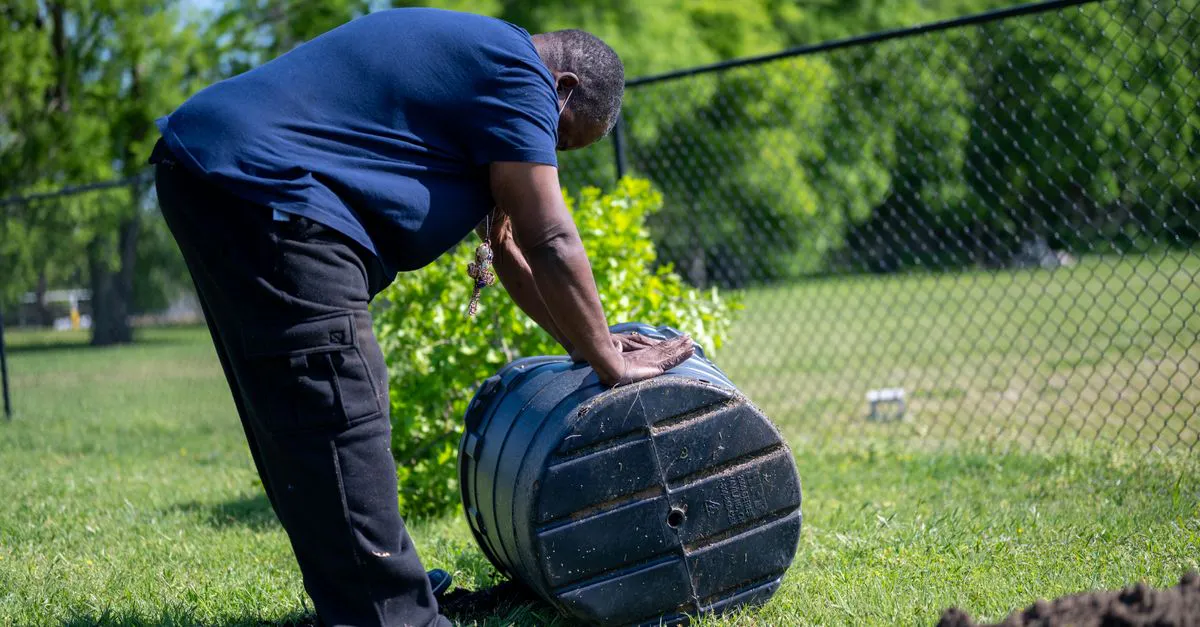
Envirocycle Composter
The Envirocycle is designed for composting on a patio, deck, or balcony. It’s a compact tumbler barrel that sits on a base tray. As the compost decomposes, liquid (compost tea) drains into the base tray through holes in the barrel. You dilute this tea 10:1 with water and use it as a liquid fertilizer. Plants go crazy for it.
The capacity is small, about 17 gallons. That’s the trade-off for the compact footprint. A single person or a couple can keep up with it. A family of four will fill it fast. The BPA-free plastic is thick and durable. The barrel sits on rollers in the base tray, so you spin it by pushing it along the tray. It’s a different motion than axle-mounted tumblers, but it works.
The sealed design means no smell escapes. No rodents can get in. No flies buzzing around. This matters a lot on a patio where you’re sitting ten feet away from your compost. You could place this three feet from your back door and nobody would know it’s a compost bin.
At $150-200, it’s pricey for the capacity. You’re paying for the compact design and the compost tea collection. If space isn’t your constraint, the VIVOSUN gives you 4x the capacity for less money. But if your “yard” is a condo patio, the Envirocycle is one of the few options that works.
GEOBIN Expandable Compost Bin
The GEOBIN is a roll of perforated black plastic that you form into a circle and fasten with the included clips. That’s it. It’s a cylinder you fill with yard waste. There’s no lid, no base, no moving parts. And it works surprisingly well.
The adjustable diameter lets you make a bin anywhere from 2 to 4 feet across. At 3 feet wide and 3 feet tall, it holds about 216 gallons. That’s enormous compared to any tumbler. If you have a lot of leaves in fall, grass clippings in summer, or garden waste to process, nothing else on this list handles the volume.
The open design means you can reach in with a fork and turn the pile easily. Air circulates through the perforations. Decomposition is slower than a tumbler (3-6 months) because there’s less heat retention, but the volume makes up for it. When the bottom layer is finished, lift the bin off, move it aside, and shovel out the dark, crumbly compost from the bottom.
At $25-35, it’s the cheapest composting solution that actually works. The downsides are obvious. No animal protection. Raccoons, skunks, and rats will visit if you put food scraps in it. Stick to yard waste and garden trimmings in a GEOBIN. Use a tumbler or worm bin for kitchen scraps.
Worm Factory 360
Vermicomposting (worm composting) produces the best compost you can make. Worm castings are basically black gold for your garden. They’re loaded with beneficial microbes, nutrients, and humic acids that processed compost can’t match. A handful of worm castings in your planting hole does more than a shovelful of regular compost.
The Worm Factory 360 is a stackable tray system. You start with one tray of bedding and red wiggler worms. Add kitchen scraps. When that tray is full, add a new tray on top. The worms migrate upward toward the fresh food, leaving finished castings in the bottom tray. You harvest the bottom tray and move it to the top. The cycle continues.
This system works indoors. A basement, garage, or even under the kitchen counter. Red wiggler worms are odorless when the bin is properly maintained. The Worm Factory has a spigot at the bottom for draining excess liquid. Keep the bedding moist but not soggy, and the only smell you’ll notice is a mild earthy scent.
You need to buy the worms separately (about 1,000 red wigglers, $30-40 from a worm farm). The kit includes bedding, a brick of coco coir, and instructions. Start slow. Feed the worms about half a pound of food scraps per day initially. As the population grows, they can handle more.
The main limitation is capacity. A Worm Factory handles kitchen scraps but not yard waste. You’re not going to process a bag of leaves through it. It’s a kitchen scrap processor, not a yard waste solution. Pair it with a GEOBIN or tumbler for a complete system.
SCD Probiotics All Seasons Bokashi Bucket
Bokashi is the wild card. It’s not composting in the traditional sense. It’s fermentation. You layer kitchen scraps with bokashi bran (wheat bran inoculated with beneficial microbes) in a sealed bucket. The microbes anaerobically ferment the food waste over 2-3 weeks. What comes out is a pickled pre-compost that you bury in garden soil or add to a regular compost pile to finish breaking down.
The big advantage: bokashi handles everything. Meat, dairy, bones, cooked food, citrus, onions. All the stuff you can’t put in a worm bin or that attracts animals to a regular compost pile. If you cook a lot and most of your waste is cooked food scraps, bokashi makes sense where other methods don’t.
The SCD Probiotics kit comes with two buckets (so one can ferment while you fill the other) and a bag of bokashi bran. The sealed lid keeps odors contained. When you open it to add scraps, there’s a sweet-sour fermented smell, like pickles. Close it up and the smell stays inside.
The ongoing cost of bokashi bran is the drawback. A bag lasts 2-3 months for an average household and costs $15-25. That adds up. And the fermented output isn’t finished compost. You need to bury it in soil (where it breaks down in 2-4 weeks) or add it to a traditional compost bin. Bokashi is a pre-processing step, not a complete system.
How We Picked These
Our selection focused on these criteria:
Practicality for small properties. Every option on this list works in a small yard, patio, or indoors. We excluded large-scale compost systems designed for farms or estates.
Odor and pest control. Neighbors exist. A composting method that smells or attracts rats isn’t viable in a close-quarters setting. Each option here has a mechanism for managing both.
Speed to finished compost. Time matters. We favored systems that produce usable compost faster, with bonus points for continuous-cycle designs.
Ease of use. If you have to wrestle with it, you’ll stop using it. Simple loading, turning, and harvesting were prioritized.
Frequently Asked Questions
Bottom Line
Get the VIVOSUN tumbler if you want one system that handles everything a typical household generates. It’s fast, clean, and affordable. Add a GEOBIN for $25 if you have a lot of fall leaves or yard waste. If you want the best quality compost for your garden, a Worm Factory 360 produces castings that nothing else can match. And if your kitchen waste is heavy on meat, dairy, and cooked food, bokashi is the only method that handles it all.
Start with one method. Get comfortable with it. Then add a second if you need more capacity or want to process different types of waste. Composting doesn’t need to be complicated. It just needs to be consistent.