
A greenhouse changed my growing season from 5 months to 9. That’s not marketing hype. In zone 5, I was done by October and couldn’t start until late May. With an unheated polycarbonate greenhouse, I’m starting seeds in March and growing cold-hardy greens through November. The math on season extension alone makes a greenhouse worth it.
But buying the wrong greenhouse wastes money fast. The $50 pop-up from Amazon? It’ll blow across your yard in the first storm. The $3,000 glass cathedral? Overkill for most backyard growers. The sweet spot for most people is a polycarbonate panel greenhouse in the $500-1,500 range.
Here’s what actually matters when choosing a greenhouse kit. Panel material is number one. Twin-wall polycarbonate insulates far better than single-layer plastic film or glass. It diffuses light evenly (no hot spots that burn plants) and survives hailstorms that would shatter glass. Frame material matters too. Aluminum won’t rust. Steel will, unless it’s galvanized and you maintain it. Wood looks nice but needs constant upkeep.
Wind and snow ratings get overlooked until your greenhouse is in pieces after the first nor’easter. If you get real winter weather, you need a frame rated for it. And ventilation is critical. A greenhouse without vents becomes a 140-degree oven in summer. You need at least one roof vent and ideally a side or door vent for cross-flow.
Palram Mythos 6x8 Greenhouse
The Palram Mythos is the greenhouse I recommend to almost everyone who asks. It hits the sweet spot of price, quality, and size. The 6x8 footprint gives you 48 square feet of growing space. That’s enough for two benches of seed starts, a few in-ground tomato plants, and room to actually move around inside.
The 4mm twin-wall polycarbonate panels are the star of the show. They insulate better than glass, weigh less, and won’t shatter if a branch falls on them. The diffused light they provide is actually better for plants than clear glass because it distributes evenly without burning foliage. The panels slide into the aluminum frame channels, so no glazing compounds or clips to deal with.
The included roof vent opens manually with a handle. I strongly recommend adding an automatic vent opener (about $25 on Amazon). It uses a wax cylinder that expands with heat and opens the vent without electricity. Otherwise you’ll forget to open it one sunny morning and come home to cooked plants.
Assembly is the rough part. Plan a full day with a helper. The instructions are adequate but not great. The aluminum frame pieces look similar and it’s easy to mix them up. Label everything as you unpack. Once built, the Mythos is solid. It handles moderate snow and wind without issues. If you’re in an area with heavy snow or strong sustained winds, anchor it to a concrete or timber base.
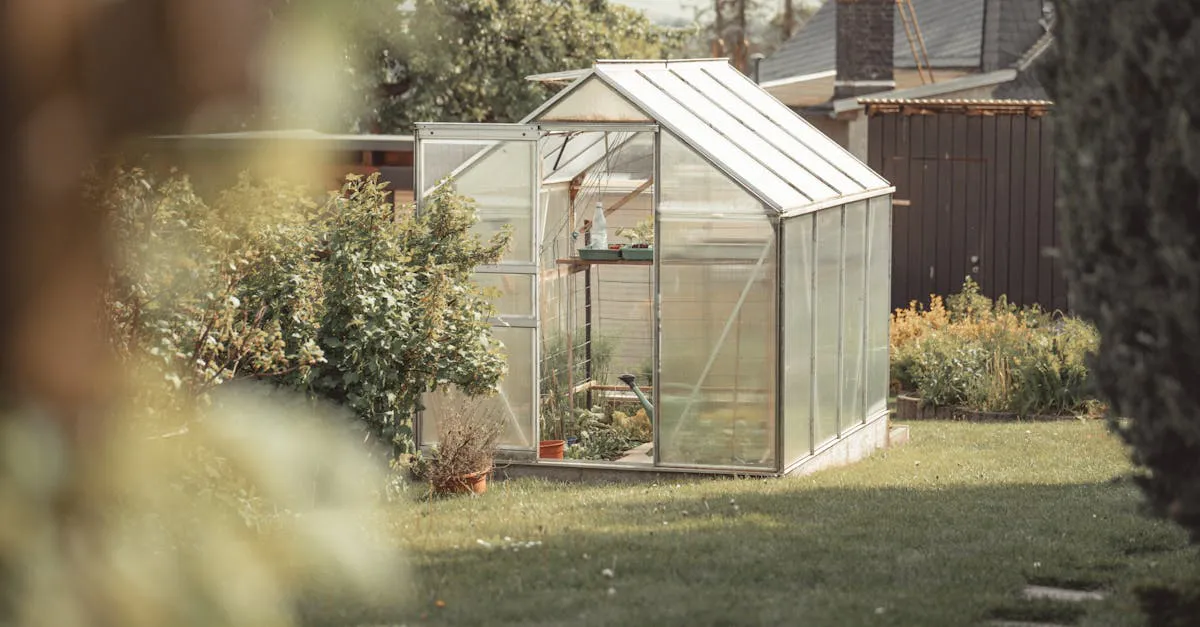
Grandio Element 6x8 Greenhouse
The Grandio Element is what you buy when you live somewhere with real winters and you want a greenhouse that can handle it. The 10mm twin-wall polycarbonate panels are more than twice the thickness of the Palram Mythos. That translates to noticeably better insulation. In cold climates, this difference matters. An unheated Grandio stays 10-15 degrees warmer than outside on winter nights, compared to 5-8 degrees for thinner-panel greenhouses.
The snow load rating of 50 lbs per square foot is commercial-grade. Most hobby greenhouses top out at 15-20 lbs/sqft. If you’ve ever woken up to find your greenhouse collapsed under wet snow, you understand why this matters. The aluminum frame is thicker gauge than competing models, with internal gussets at stress points.
Two roof vents and a side vent come standard. The sliding door is smoother than the hinged doors on cheaper models. Interior channels in the frame are designed for shelf brackets, so you can add growing benches without drilling.
The price reflects the quality. At $1,200-1,500, the Grandio costs 2-3 times more than a Palram. Whether that’s worth it depends on your climate and commitment level. If you plan to grow year-round in zones 3-6, the extra insulation and snow rating pay for themselves. If you’re in a mild climate, the Palram does the same job for less.
Quictent 6x8 Portable Greenhouse
Let’s be clear about what this is and isn’t. The Quictent is a PE (polyethylene) cover over a lightweight steel tube frame. It’s not a real greenhouse in the structural sense. It’s a glorified tent for plants. And for the price, that’s perfectly fine.
You set it up in 30 minutes by yourself. The frame poles slide together and the cover goes over the top. Guy wires anchor it to the ground. Roll-up door and side windows provide ventilation. It creates a sheltered microclimate that’s 10-20 degrees warmer than outside in spring and fall.
Where the Quictent shines is season extension on a budget. Starting seeds 4-6 weeks early, hardening off transplants, protecting tender plants from late frost. It does all of these jobs well enough for under $120. If a spring storm rips the cover, you’re out $40 for a replacement, not $400.
The PE cover will degrade in UV light. Plan on replacing it every 1-2 seasons. The frame rusts if the paint chips. Stakes and guy wires are mandatory, not optional. Without them, this thing becomes a kite in 20 mph winds. I’ve seen them blow into trees.
For the price, it’s hard to complain. Just don’t expect it to perform like a polycarbonate greenhouse. It’s a seasonal tool, not a permanent structure.
Rion Sun Room 2 Lean-To Greenhouse
A lean-to greenhouse mounts against an existing wall of your house, garage, or shed. This design has a unique advantage: the wall radiates stored heat at night, keeping the greenhouse warmer than a freestanding structure. In cold climates, that passive heat can mean the difference between plants surviving a freeze or not.
The Rion Sun Room 2 is one of the better lean-to kits available. The polycarbonate panels attach to an aluminum frame that bolts to your wall. The 6x8 footprint (measured from the wall outward) gives you a narrow but usable growing space. It’s especially good for side yards or other tight spaces where a freestanding greenhouse won’t fit.
Setup requires drilling into your house wall, which some people aren’t comfortable with. You need to ensure proper flashing and sealing at the attachment point to prevent water infiltration. The kit includes a door on one end and a vent on the roof. Access from inside your house (through a window or door) is a bonus if the lean-to aligns with an entry point.
The limitation is that lean-tos only get sun from one long side and the top. The wall side is always shaded. This means less total light than a freestanding greenhouse. It’s fine for shade-tolerant crops and season extension, but high-light crops like tomatoes and peppers produce better in freestanding structures.
Bootstrap Farmer Caterpillar Tunnel
If you’re growing in rows, not on benches, a caterpillar tunnel is the most efficient way to protect your crops. Bootstrap Farmer makes commercial-quality tunnels sized for small farms and serious home gardens. These are hoop houses, meaning galvanized steel hoops bent into arches and covered with greenhouse-grade poly film.
The “caterpillar” design is narrower than a full high tunnel (typically 8-10 feet wide) and can be moved between garden sections as needed. You set it up over a row of crops in spring and remove it when temperatures stabilize. In fall, move it over your winter greens.
Bootstrap Farmer’s kits use 1-3/8 inch galvanized steel tubing, which is a step above the lightweight conduit used in DIY hoop house plans. The frame clips, wiggle wire, and channel are commercial grade. The poly film is sold separately, which lets you choose your weight and UV treatment.
This is not an insulated greenhouse. There’s no heating benefit beyond wind protection and frost buffering. Think of it as a professional row cover system. For market gardeners or anyone growing to preserve, caterpillar tunnels dramatically increase yield and quality by keeping rain off crops and providing a few degrees of frost protection.
Bootstrap Farmer Caterpillar Tunnel
Outsunny 6x3 Portable Walk-In Greenhouse
The Outsunny is the cheapest walk-in greenhouse you can find. At $50-80, it’s essentially a tall plant shelf with a plastic cover. And that’s exactly how you should use it. Put it on your patio or deck, fill it with seed trays in spring, and use it for hardening off transplants before they go in the garden.
The wire shelving inside holds maybe 6-8 standard seed trays. The PE cover zips open in front for access and has small mesh windows on the sides. The frame is thin steel tubing that flexes noticeably. This is not a wind-tolerant structure. Place it against a wall or fence for protection.
I’m giving it a 3-star rating because it does exactly one thing: it keeps seed starts warm on your patio in spring. If that’s all you need, $60 is a steal. If you expect it to function as a real greenhouse for growing full-size plants, you’ll be disappointed. The shelf spacing is too tight for anything taller than 12 inches.
Consider this a stepping stone. Use it for a season, decide if greenhouse growing is for you, then invest in a Palram or Grandio for the real thing.
How We Picked These
Selection criteria for this roundup:
Panel material and insulation value. Twin-wall polycarbonate is the standard for permanent hobby greenhouses. We rated thicker panels higher because insulation directly impacts how much you can extend your season.
Structural integrity. We checked wind ratings, snow load ratings, and frame gauge. A greenhouse that collapses in the first storm is worse than no greenhouse because you’ve lost the money and the crops inside.
Ventilation. At minimum, one operable roof vent. Extra credit for multiple vents and cross-ventilation capability.
Value for the intended use. A $60 pop-up that works perfectly for patio seed starting deserves the same recognition as a $1,200 premium model that handles blizzards. Each greenhouse was rated within its own category.
Frequently Asked Questions
Bottom Line
The Palram Mythos 6x8 is the right greenhouse for most backyard growers. It’s well-built, properly insulated, and priced reasonably. If you live where winters hit hard, the Grandio Element is worth the upgrade for the thicker panels and snow rating. Need something cheap to test the waters? The Quictent portable greenhouse gets you started for under $120. Just stake it down properly and don’t expect it to survive a real storm.
Whatever you choose, add an automatic vent opener. It’s a $25 investment that prevents the most common greenhouse disaster: cooking your plants on a sunny day when you’re not home to open the vent.